
1st May, 2026
When LLMs Stop Following Steps: A Diagnostic Study of Procedural Execution in Language Models
EACL 2027 Main Conference
Sailesh Panda, Pritam Kadasi, Abhishek Upperwal, Mayank Singh · IIT Gandhinagar & Soket AI
📄 Paper: arXiv:2605.00817
Introduction and Motivation
Large language models (LLMs) show strong performance on many reasoning tasks, including arithmetic, symbolic manipulation, multi-step question answering and code generation. But strong final-answer performance does not necessarily mean the model faithfully executed the intended procedure.
This matters for procedure-following tasks, where a model must carry out a specified multi-step procedure, track intermediate states, apply operations in order and stop at the right point. Prior work shows LLMs often rely on shortcut heuristics or unstable computations, and can fail even when the complete procedure is given to them.
We study arithmetic procedural execution: a model's ability to carry out an explicitly specified arithmetic procedure and return the correct final value. Because the reference output is deterministic, there is no ambiguity about the right answer, so execution can be studied under controlled conditions.
We address two research questions:
- RQ1: How does model accuracy change as procedures get longer and require deeper look-back dependencies?
- RQ2: What generation-level failure modes emerge during execution, and how do they relate to final-answer accuracy?
Average first-answer accuracy drops from 63% on 5-step procedures to 20% on 95-step procedures.
Task Formulation
Each example gives the model a step-wise procedure and two numeric inputs, x and y. The procedure sets S1 = x and S2 = y, then defines each later variable from earlier ones using +, −, × or ÷. The model must execute the procedure exactly and return only the final value.
function(x, y):
    Let S1 = x
    Let S2 = y
    Step 1: S3 = S1 + S2
    Step 2: S4 = S3 - S2
    Step 3: S5 = S4 / S2
    Step 4: S6 = S5 * S3
    Step 5: S7 = S6 - S4
    Final Step: Return S7
Later steps reuse variables from several steps earlier. For example, Step 5 computes S7 from S6 and S4, so the model has to retrieve a value produced two steps before. This makes the task a test of procedural state tracking, not only arithmetic.
Benchmark Design
Complexity is increased along two axes while each individual operation stays simple:
- Procedure length: from 5 to 95 steps, in increments of 10.
- Look-back dependency: at each step, the two operands are drawn from the last
kintermediate variables, withkfrom 1 to 7.
| Attribute | Setting |
|---|---|
| Input ranges | [0, 1], [1, 10], [10, 100] |
| Data types | Floating point for [0, 1]; integer and floating point for the others |
| Operation variants | Addition, subtraction, multiplication, division only, and mixed |
| Procedure lengths | 5 to 95 steps (100 examples per length) |
| Look-back depth | 1 to 7 |
| Total | 55 datasets, 55,000 examples |
| License | CC-BY 4.0 |
Reference outputs come from a deterministic executor that runs each step in order. Edge cases such as division by zero, infinities and NaNs are kept on purpose, to see whether models propagate or report them correctly.
Models Evaluated
We evaluate 15 open models, from 1.5B parameters to over 1T, grouped into five scales.
| Scale | Models |
|---|---|
| Small (under 4B) | DeepSeek-R1-Distill-Qwen-1.5B, Qwen3-4B-Thinking-2507 |
| Mid-scale (4B–8B) | Olmo-3-7B-Think, Mistral-7B-Instruct-v0.3, DeepSeek-R1-Distill-Qwen-7B, OpenThinker2-7B |
| Large (14B–18B) | Ministral-3-14B-Reasoning, DeepSeek-R1-Distill-Qwen-14B, Qwen3-14B |
| Very large (20B–30B) | Magistral-Small-2509, Sarvam-30B, NVIDIA-Nemotron-3-Nano-30B |
| Frontier (over 100B) | OpenAI-OSS-120B, DeepSeek-V3.2, Kimi-K2.5 |
All models use the same prompt, deterministic decoding (temperature 0) and a 32,768-token generation limit. Models are asked to put the final value inside <answer> tags. The full evaluation took about 300 GPU hours on NVIDIA H200 GPUs.
Metrics
| Metric | What it measures |
|---|---|
| First-Answer Accuracy (FAA) | Whether the first answer the model gives is correct |
| Correct@Any (CAA) | Whether any answer in the output is correct |
| Parseable Answer Rate (PAR) | Share of outputs with at least one valid tagged answer |
| Answer Position (AP) | How early in the output the first answer appears |
| Step-Following Behavior (SFB) | Whether the model executes fewer, exactly as many, or more steps than asked |
Results
Accuracy falls as procedures get longer
Across models and settings, FAA declines steadily as the number of steps increases. Averaged across models, the gap between 5-step and 95-step procedures is about 43 percentage points. Several models, including NM-30, DS-7, QW-4, KK-1T, OA-120 and DS-14, drop by more than 55 points.
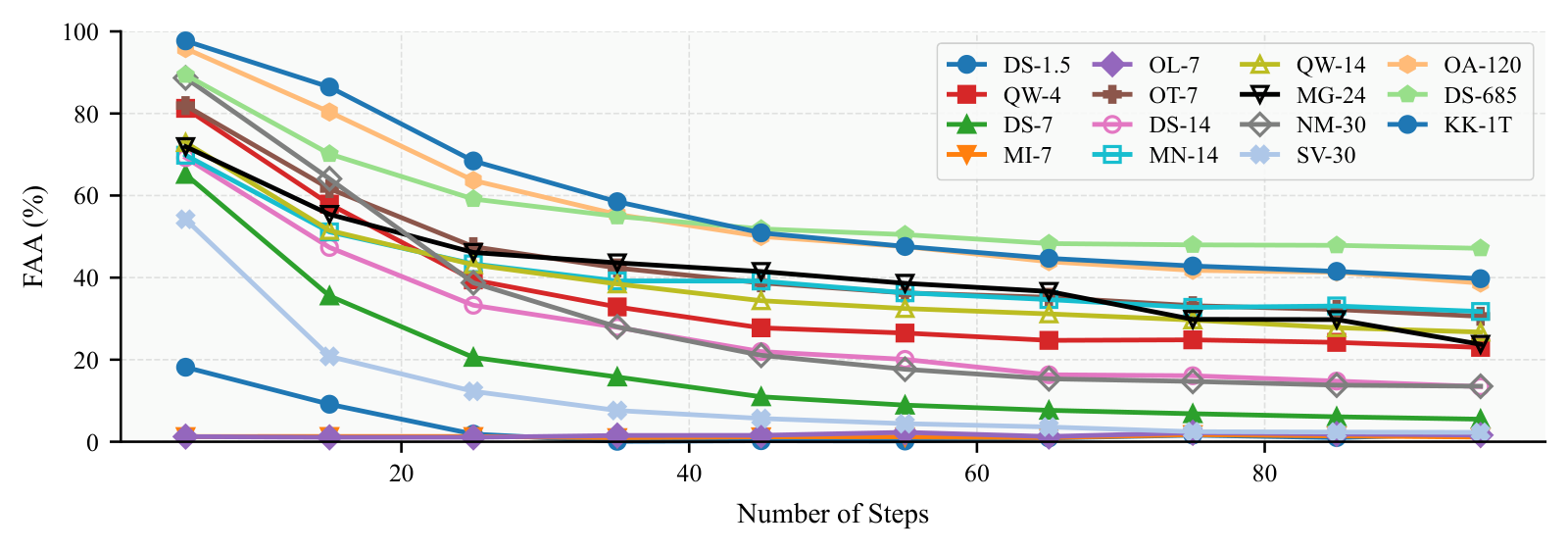
First-answer accuracy as a function of procedure length (5–95 steps). Performance declines with more steps for every model, even though each individual operation is simple.
Models rarely recover after a wrong first answer
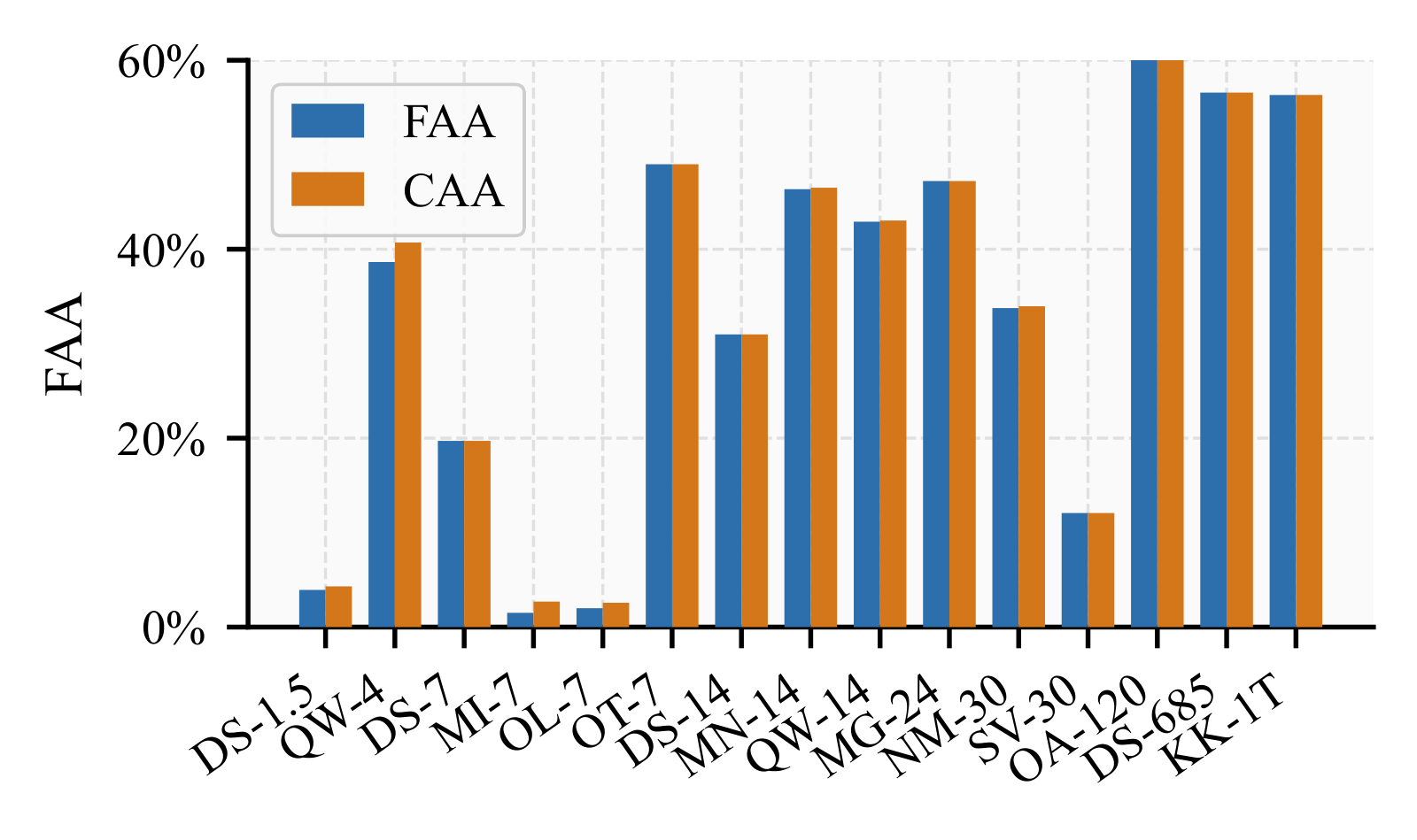
The mean difference between FAA and CAA is only about 0.0003, so models almost never produce the correct answer later in the same output after an incorrect first one. A few smaller models show larger gaps, but this behavior is largely absent in larger reasoning models.
Deeper look-back makes it harder
Increasing dependency depth, from using only the previous variable to using variables up to seven steps back, lowers average accuracy by a further 23.85 percentage points. Most models degrade more as the look-back depth grows, which points to difficulty retrieving and combining non-local intermediate states.
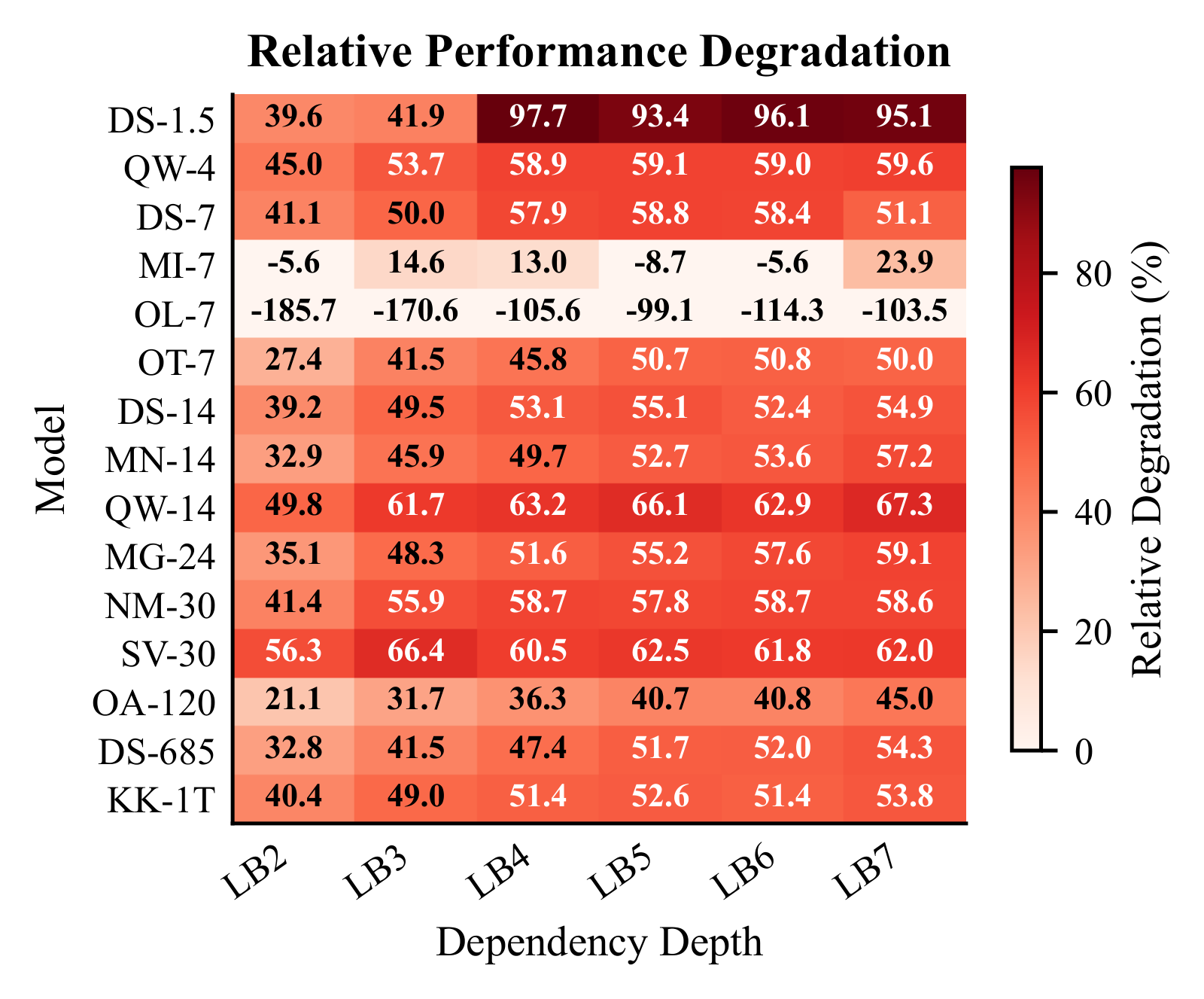
Relative FAA drop on the mixed-operation benchmark, compared with each model's look-back 1 baseline. Larger values mean greater sensitivity to long-range dependencies.
Input and Task Factors Don't Fully Explain It
Input range and data type
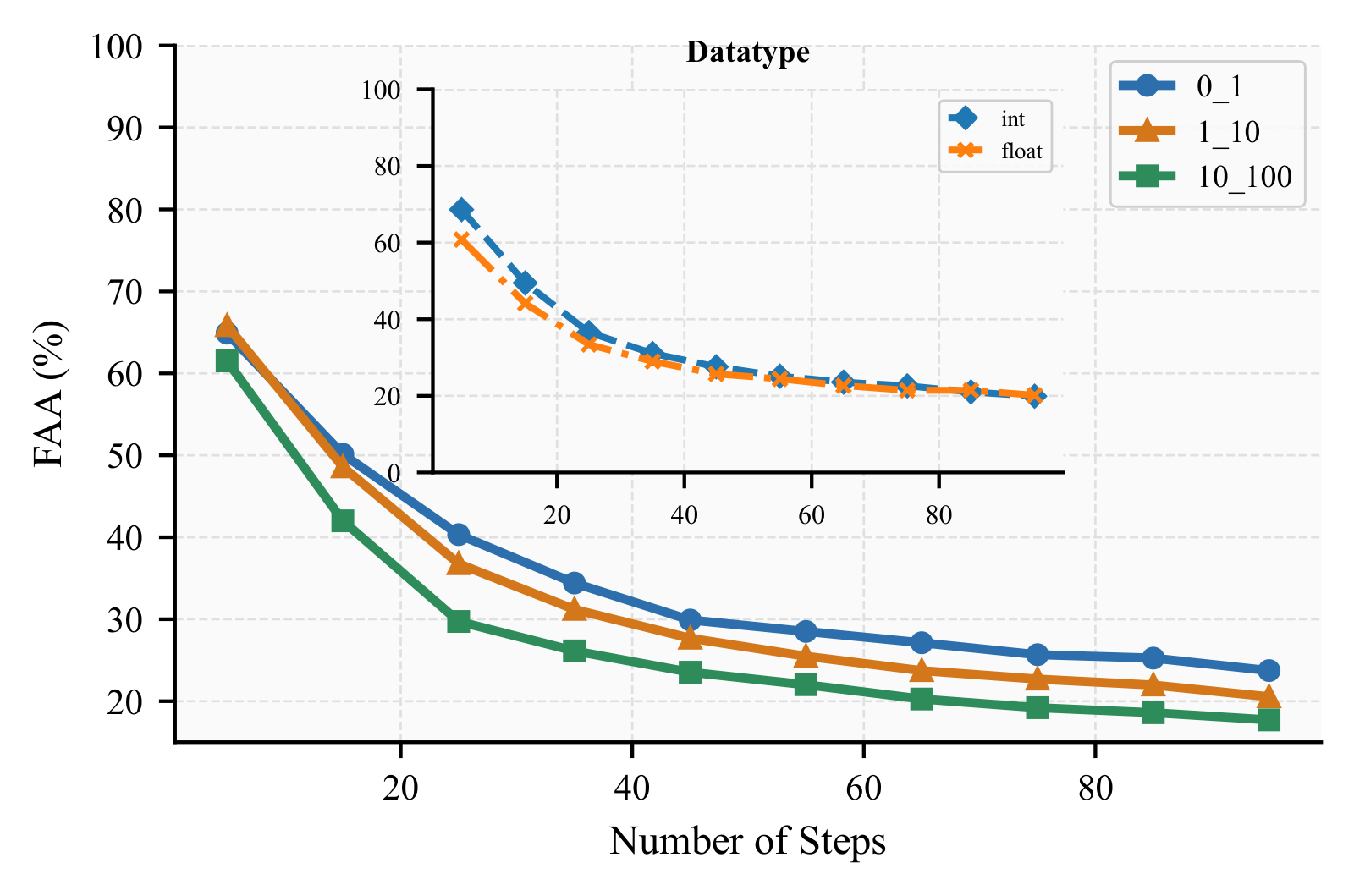
FAA falls with step count across all input ranges. The [0, 1] range scores slightly higher, by 4.14% on average. Integer and floating-point inputs follow nearly the same downward trend, with an average difference of only 2.26%, though individual models lean one way or the other.
Operation type
Addition and subtraction outperform multiplication and division by 34.74% on average. Multiplication and division produce far more extreme values: multiplication outputs span over 10190 in magnitude, and division blows up near zero denominators. Mixed-operation tasks lower FAA by a further 22.06% compared with single-operation tasks, which suggests switching between operators adds difficulty.
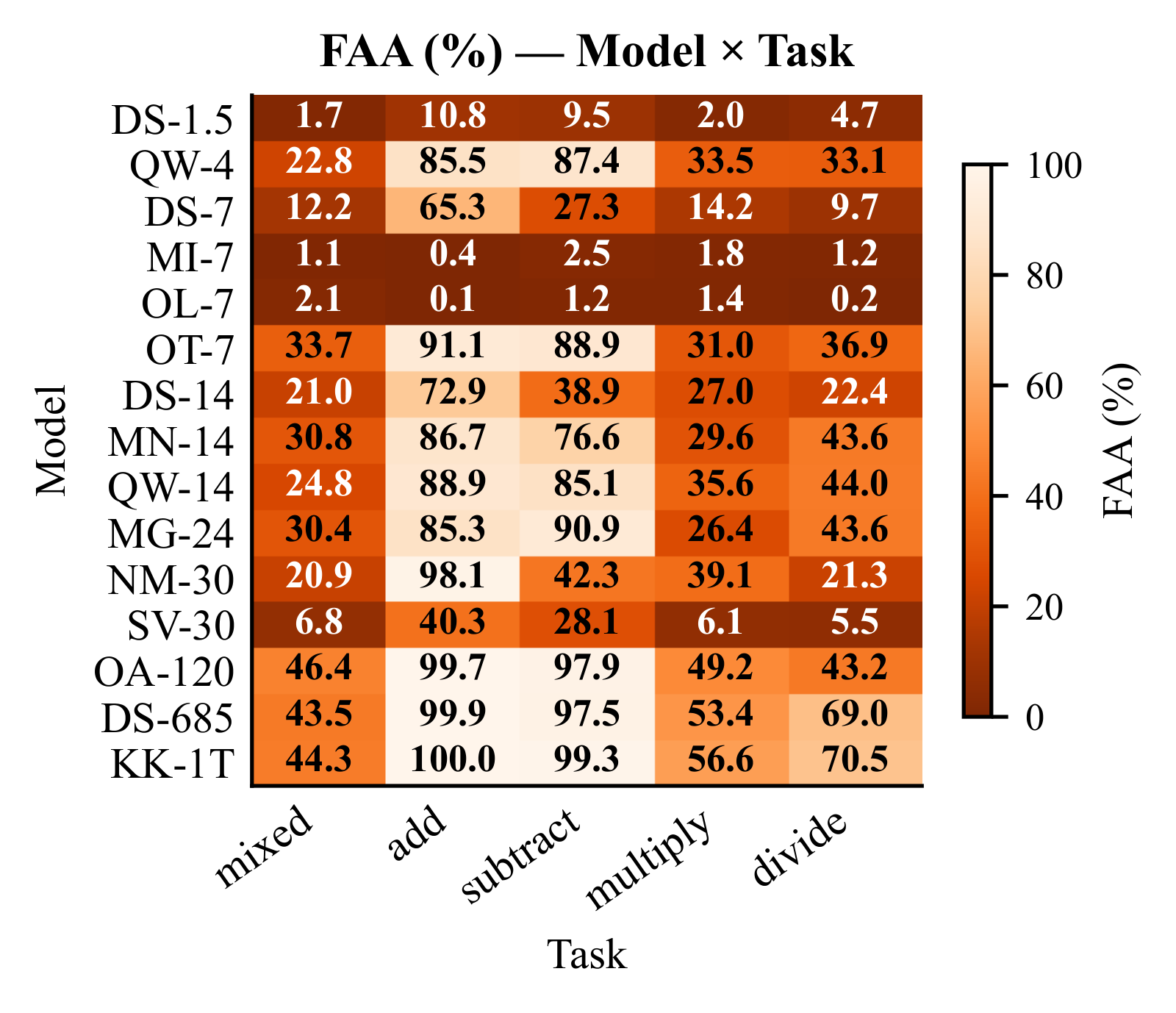
Output magnitude may contribute to failures in some settings, especially multiplication and division, but it does not explain the broader decline as procedures get longer.
Generation-Level Failure Modes
Missing answers
Averaged across models, the Parseable Answer Rate drops by 24.63% from 5-step to 95-step procedures: on long procedures, models more often fail to produce any valid tagged answer. OA-120, DS-685, KK-1T, OL-7 and QW-4 are the most robust; DS-7, SV-30, MG-24, NM-30 and DS-1.5 degrade the most.
When models commit to an answer
OA-120 often answers very early in its output without writing out the intermediate steps. Other models, such as QW-4, NM-30 and SV-30, also answer early in relative terms, but only because they write all the steps first and then continue with a long trace afterwards. So answer position reflects generation style more than shortcut reasoning.
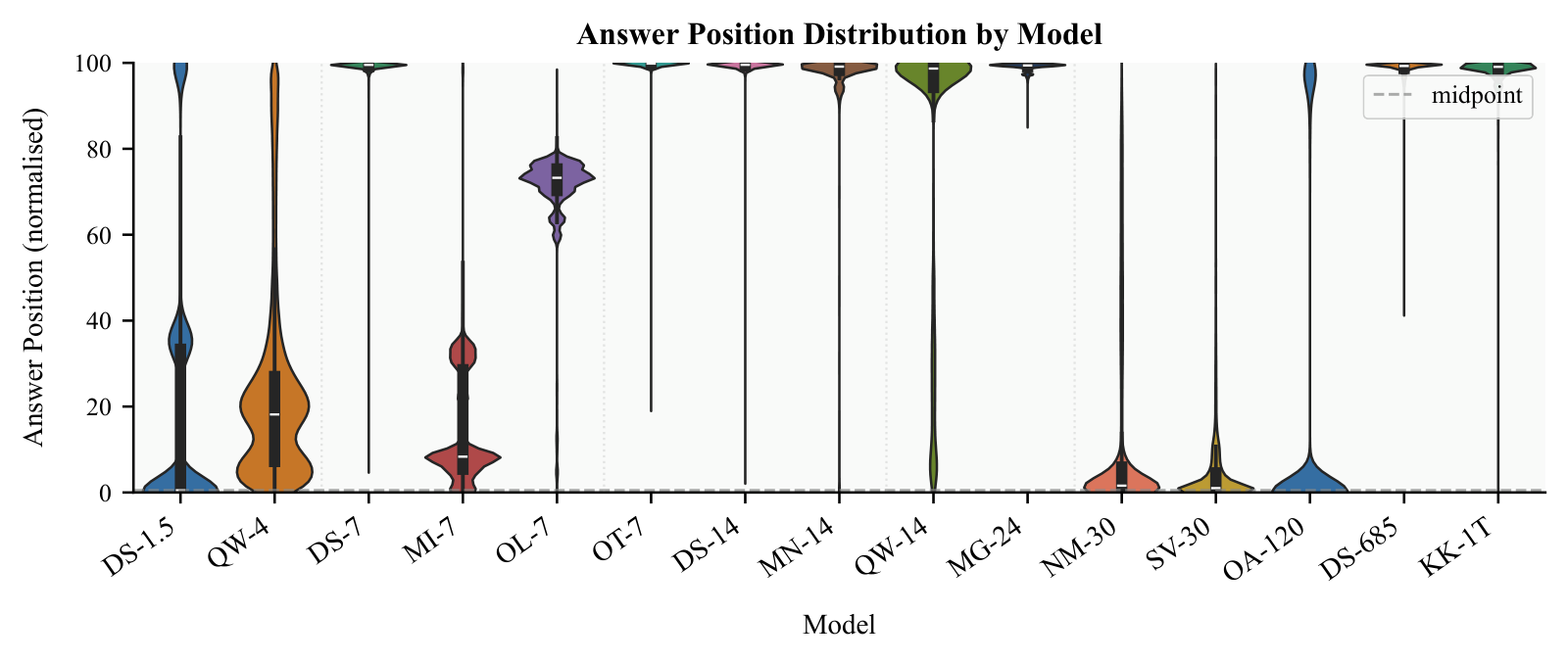
Under-execution grows with length
As procedures get longer, exact execution becomes less common and under-execution, stopping before all the steps are done, becomes more common.
| Model | Parseable answers drop | Exact execution drop | Under-execution rise |
|---|---|---|---|
| DS-7 | 60.8 | 57.0 | 45.8 |
| QW-4 | 4.4 | 54.0 | 53.8 |
| MG-24 | 42.4 | 38.1 | 38.1 |
| MI-7 | 15.3 | 34.1 | 39.8 |
| OT-7 | 15.5 | 23.4 | 23.4 |
| KK-1T | 12.1 | 20.45 | 20.45 |
| QW-14 | 16.6 | 17.7 | 17.6 |
| DS-685 | 12.5 | 12.9 | 12.9 |
| OA-120 | 13.3 | 2.7 | 2.7 |
Change in percentage points from 5-step to 95-step procedures, for a selection of models. Figures from the paper.
Conclusion and Future Work
On a controlled benchmark for multi-step arithmetic execution, performance consistently falls as procedures get longer and as steps depend on values further back. Failures often come with missing answers, premature answers and under-executed traces, so arithmetic errors alone don't explain the decline. Apparent reasoning ability can hide real weaknesses in faithfully executing instructions.
Next, we plan to extend the benchmark to branching procedures, symbolic transformations, natural-language workflows and tool-using agents.
Limitations
The study uses synthetic arithmetic tasks, which may not generalize to all reasoning domains. It does not cover branching logic, semantic reasoning, tool use or interactive decision-making, and does not evaluate commercial frontier models.
Read the full paper on arXiv: When LLMs Stop Following Steps: A Diagnostic Study of Procedural Execution in Language Models